
Why Most Habit Trackers Fail
You've probably tried habit tracking before. Maybe you used a bullet journal, a habit app, or even just a simple checklist. And like most people, you probably gave up after a few weeks.
Here's the problem: most habit trackers only track. They don't motivate. Checking a box feels good for about three days, then it becomes another chore on your to-do list.
What if your habit tracker actually rewarded you? Not with fake badges or meaningless streaks, but with real rewards you choose for yourself? That's the approach behind point-based habit tracking.
The Science of Self-Reward
Behavioral psychology has known for decades that immediate rewards drive behavior change. It's why kids respond so well to point systems - the connection between action and reward is clear and immediate.
Adults need the same thing. The problem is:
- Long-term goals feel too distant ("I'll feel better in 6 months")
- We're bad at rewarding ourselves ("I don't deserve a treat yet")
- Willpower depletes throughout the day
- Abstract progress doesn't trigger dopamine
A point-based reward system solves this by making progress tangible and rewards guilt-free.
How PointWiseSystem Works for Personal Habits
The Personal Habit Tracking profile is designed for adults who want to build better habits and actually stick with them.
Track What Matters to You
Pre-loaded habits include:
- 🏃 Morning workout (15 points)
- 💧 Drink 8 glasses of water (10 points)
- 📵 No social media for 2 hours (10 points)
- 📖 Read for 30 minutes (10 points)
- 🧘 Meditate for 10 minutes (10 points)
- 🥗 Eat a healthy meal (8 points)
- 📝 Journal entry (8 points)
- 💤 Sleep 8 hours (10 points)
Customize these or add your own. Learning a language? Add "Duolingo lesson (10 points)." Training for a marathon? Add "Run 5K (20 points)."
Rewards You Actually Want
This is where it gets fun. You define what you're working toward:
🎁 Example Reward Menu
- Small (20-50 points): Nice coffee, favorite snack, guilt-free TV episode, 30 min gaming
- Medium (75-150 points): Movie night, new book, nice dinner out, new clothing item
- Big (300-800 points): Day trip adventure, tech gadget, concert tickets, weekend getaway
The key insight: you're not "treating yourself" randomly. You're earning rewards through consistent effort. This removes the guilt and makes rewards feel deserved.
💡 The Psychology Behind It
When you earn 50 points and redeem them for "Order favorite takeout," your brain connects the habit completion to the reward. Over time, the habits themselves become rewarding. This is how lasting behavior change happens.
Real Examples: How People Use It
The Fitness Journey
Sarah wanted to exercise more consistently. She set up:
- Morning workout: 15 points
- Evening walk: 8 points
- Stretch routine: 5 points
Her rewards: New workout clothes (200 points), massage (400 points), fitness tracker (800 points). After 3 months, she'd earned her fitness tracker and exercise had become automatic.
The Digital Detox
Mike was spending too much time on his phone. He tracked:
- No social media before noon: 10 points
- Phone-free dinner: 8 points
- No screens after 9pm: 10 points
His rewards were intentionally analog: new book, coffee shop visit, hiking trip. The irony of using an app to reduce phone use wasn't lost on him, but it worked.
The Side Project
Lisa wanted to write a novel but kept procrastinating. She tracked:
- Write for 30 minutes: 15 points
- Write 500 words: 20 points
- Edit a chapter: 25 points
Small rewards kept her going (nice tea, episode of her show), and she finished her first draft in 4 months.
Tips for Success
1. Start Small
Don't track 15 habits on day one. Pick 3-5 that matter most. Add more once those are consistent.
2. Make Rewards Proportional
A week of consistent habits should earn a small reward. A month should earn something meaningful. This keeps motivation high.
3. Include "Easy Wins"
Not every habit needs to be hard. "Make bed" (3 points) or "Take vitamins" (2 points) give you momentum on tough days.
4. Review Weekly
Look at your points earned. Which habits are you nailing? Which are you avoiding? Adjust point values to make avoided habits more rewarding.
5. Don't Punish - Only Reward
Missed a habit? No points. That's it. No negative points, no guilt. Tomorrow is a new day.
Why Points Beat Streaks
Many habit apps focus on streaks. "Don't break the chain!" But streaks have a fatal flaw: one bad day destroys weeks of progress.
Points are different:
- Miss a day? You still have all your previous points
- Partial effort counts (did 3 of 5 habits? That's still 30 points)
- Progress accumulates toward real rewards
- No "starting over" feeling
✨ Simple Mode: Habit Tracking Without Gamification
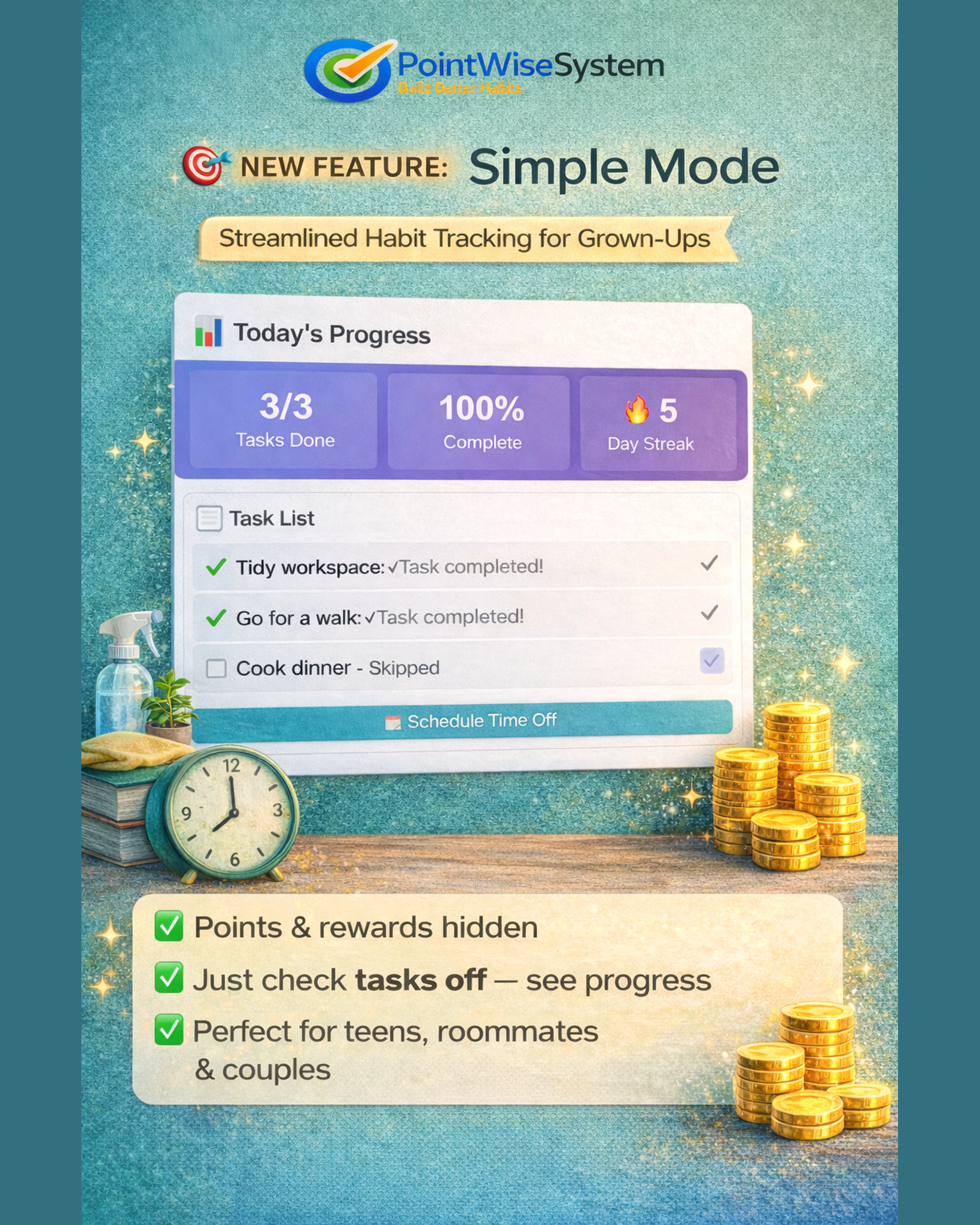
Not everyone wants points and rewards. Simple Mode offers a cleaner approach for adults who prefer straightforward task tracking.
Why Simple Mode Works for Personal Habits
Some people find points motivating. Others find them distracting or even childish. If you're in the second camp, Simple Mode is for you.
What Simple Mode Does
- Hides all points - No numbers, no accumulation, no gamification
- Pure checkboxes - Tasks become simple yes/no completions
- Removes rewards - Focus on the habit itself, not external motivation
- Clean interface - Minimal, distraction-free design
Perfect For
- Minimalists - You want a simple daily checklist, nothing more
- Intrinsic motivators - The satisfaction of completion is enough
- Professionals - Points feel inappropriate for work habits
- Habit veterans - You've built the habits, now just need tracking
How It Works
Toggle Simple Mode on in Settings. Instantly:
- Point totals disappear from the dashboard
- Tasks show as checkboxes instead of point buttons
- The rewards section is hidden
- Your interface becomes a clean, focused task list
Your points are still tracked in the background - if you ever want to switch back to the full system, everything is preserved.
Simple Mode + Recurring Tasks = Powerful Combo
Combine Simple Mode with recurring tasks for the ultimate habit tracker:
- Set up your daily habits as recurring tasks
- Enable Simple Mode for a clean interface
- Each morning, your habits reset automatically
- Check them off as you complete them
- Review your history to see patterns over time
No points to calculate, no rewards to manage - just a simple, effective system for tracking what matters.
Start Your Free Trial
The Free plan includes everything you need to get started:
- Track 2 habits (as "earners" - think of them as habit categories)
- All pre-made tasks and rewards
- 3 days of history
For custom habits, unlimited history, and features like recurring tasks, upgrade to Plus ($4.99/month).
Frequently Asked Questions
Isn't rewarding myself for basic habits... childish?
Not at all. It's behavioral science. The same principles that help kids learn responsibility help adults build habits. The difference is you choose adult rewards.
What if I cheat and give myself points I didn't earn?
You could. But you'd only be cheating yourself. Most people find that the system works because they want it to work. The rewards feel better when they're earned.
Can I use this with a partner or accountability buddy?
Yes! Add them as a co-admin (Plus plan) or create separate "earners" for each person and make it a friendly competition.
How is this different from other habit trackers?
Most habit trackers just track. PointWiseSystem connects habits to real rewards you define. It's the reward system that makes the difference.